newsfromthestates.com · September 9, 2026

Ohio farmers need help after tariffs, foreign competition bring big struggles | News From The States [ Skip to main content ](#main-content) [   Part of States Newsroom ](https://www.newsfromthestates.com/) search Sort by Latest Relevant Search Search  Stories From The States Colorado ranchers join fight against fossil fuel companies 28:57 https://play.prx.org/e?ge=prx\_14251\_3c1657e2-db5d-478b-98db-eb90ca023a81&uf=https%3A%2F%2Fpublicfeeds.net%2Ff%2F14251%2Fstoriesfromthestates.xml [   Part of States Newsroom ](https://www.newsfromthestates.com/) News ###### Ohio farmers need help after tariffs, foreign competition bring big struggles ## Share [Bluesky](https://www.newsfromthestates.com/#bluesky)[X](https://www.newsfromthestates.com/#x)[Facebook](https://www.newsfromthestates.com/#facebook)[Email](https://www.newsfromthestates.com/#email)[Copy Link](https://www.newsfromthestates.com/#copy_link)  [Ohio](https://www.newsfromthestates.com/state/ohio) [News](https://www.newsfromthestates.com/news) # Ohio farmers need help after tariffs, foreign competition bring big struggles [Gov & Politics](https://www.newsfromthestates.com/category/gov-politics) Sep 09, 2026 | 4:00 am ET By Susan Tebben Share [Bluesky](https://www.newsfromthestates.com/#bluesky)[X](https://www.newsfromthestates.com/#x)[Facebook](https://www.newsfromthestates.com/#facebook)[Email](https://www.newsfromthestates.com/#email)[Copy Link](https://www.newsfromthestates.com/#copy_link) 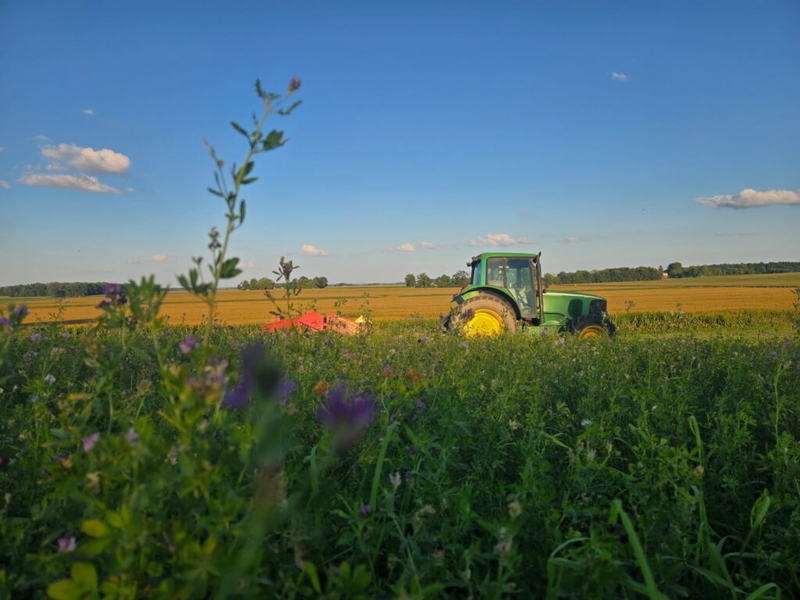 Description A tractor sits on a Chris Gibbs' Shelby County farm. (Photo courtesy of Chris Gibbs) Ohio farmers are making hard decisions to pay the bills, and bearing the brunt of criticisms about food-borne illnesses in the produce aisle. They are demanding to be heard by Congress and the Trump administration as tariffs dig into struggling farmers’ bank accounts, and partisanship threatens the Farm Bill, legislation that had bipartisan support for decades before the One Big Beautiful Bill Act changed things. Meanwhile, consumers are having trouble choosing at the grocery stores [after recalls](https://ohiocapitaljournal.com/2026/09/01/repub/a-summer-of-recalls-exposes-holes-in-the-nations-food-safety-net/) of lettuce, other produce, and even some types of meat. “Of course, farmers always get the black eye at the end of the day when that sort of stuff happens,” said Joe Logan, a beef farmer in Northeast Ohio, and president of the Ohio Farmers Union. Logan and others in the union are concerned about the cuts that have been made within the U.S. Department of Agriculture, which could have prevented some of the illnesses, or at least helped the country respond to contaminations like [cyclosporiasis](https://ohiocapitaljournal.com/2026/08/06/ohio-sees-second-week-of-significant-increases-in-cyclosporiasis-cases/). Logan specifically pointed to cuts made to the Agricultural Food Safety Inspection Service, and the fact that the government backed off of a law that required country-of-origin listings on cuts of beef, pork, and ground beef [back in 2016](https://www.federalregister.gov/documents/2016/03/02/2016-04609/removal-of-mandatory-country-of-origin-labeling-requirements-for-beef-and-pork-muscle-cuts-ground). “It was not very long ago that we would know not only the pathogen, we would know the source, because we would have surveillance in the system, and there’s a reason we do these things,” Logan said. “The USDA is being kicked around, and mismanagement is the reason.” There are currently 17 active alerts listed on the USDA’s website, which includes recalls and public health alerts. Ten of them are listed as Class 1, the highest priority for recalls. 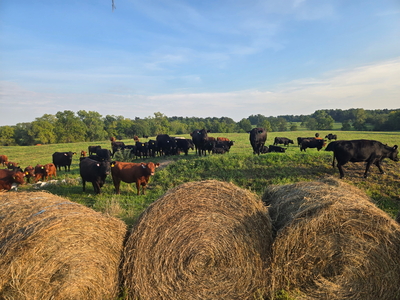 Cows graze in a field. (Photo courtesy of Chris Gibbs) While product contamination is listed for several recalls and public health alerts, seven are listed as import violations, or “produced without benefit of inspection.” Beef farmers like Logan are also facing struggles as the** **Trump administration attempts to** **[push back against tariff-induced price increases](https://www.npr.org/2026/08/26/nx-s1-5944265/ground-beef-trump-tariffs)** **by importing beef from other countries. Trade conflicts with China and Canada are also causing issues. According to Logan, two-thirds of livestock grown in Canada is sent to the U.S. “It really puts us in a tough place,” Logan said. As a fifth-generation farmer who’s seen his share of ups and downs in the marketplace, Logan said in his first year as a beef farmer (transitioning from dairy cattle), beef prices were “solid all year.” “It was kind of gratifying to think about maybe making a little money, and maybe expanding our herd,” he said. Those hopes were dimmed after the announcement that Trump planned to import beef from outside the U.S., hampering an opportunity for Logan to become more profitable. He said the choice to broaden the market as Trump tries to soften the blow of tariff prices on the American consumer sends a disappointing message to farmers. “The clear signal that it sends to cattle producers is that you can not trust this administration to come up with (policies) that are going to give us a stable enough marketplace for us to be confident about expanding our herd,” Logan said. Tariff prices are hitting farmers in many ways, from competition, to parts and materials. While preparing for corn season, Shelby County farmer Chris Gibbs replaced a drive chain on his planter, and noticed the parts number for the company on one side, and “made in China” on the other. “I don’t care where it comes from, but what I knew at that exact moment is that I paid tariff on that doggone thing,” Gibbs said. Even without tariffs in the discussion, farmers are looking for some level of predictability from the government, as participants in an industry that lives and dies by weather conditions and good crop years. When there are droughts or low commodity prices, farmers have a knack for figuring it out. “You do it, you move money around, you dig nickels out of the couch, you put off buying capital assets,” Gibbs said. “You make do.” But the recent changes from the One Big Beautiful Bill Act and a Farm Bill that has been limping along without a full renewal since 2018 have created a “cash-flow working capital crisis in agriculture,” according to Gibbs. That crisis revolves less around large corporation farms and more on those that actually grow the food for Americans, according to Logan. “We have a livestock-centric policy right now that leaves the people that actually produce food that people eat kind of out in the cold, in terms of agricultural policy and subsidy support,” Logan said. In December of last year, Gibbs headed to his supplier to pick up inputs like fertilizer and seed, and realized he couldn’t afford them because of the cost of production. “I didn’t have the money,” G