mdebaugh.substack.com · Mike DeBaugh, JD, MBA, DBA(e) · September 7, 2026
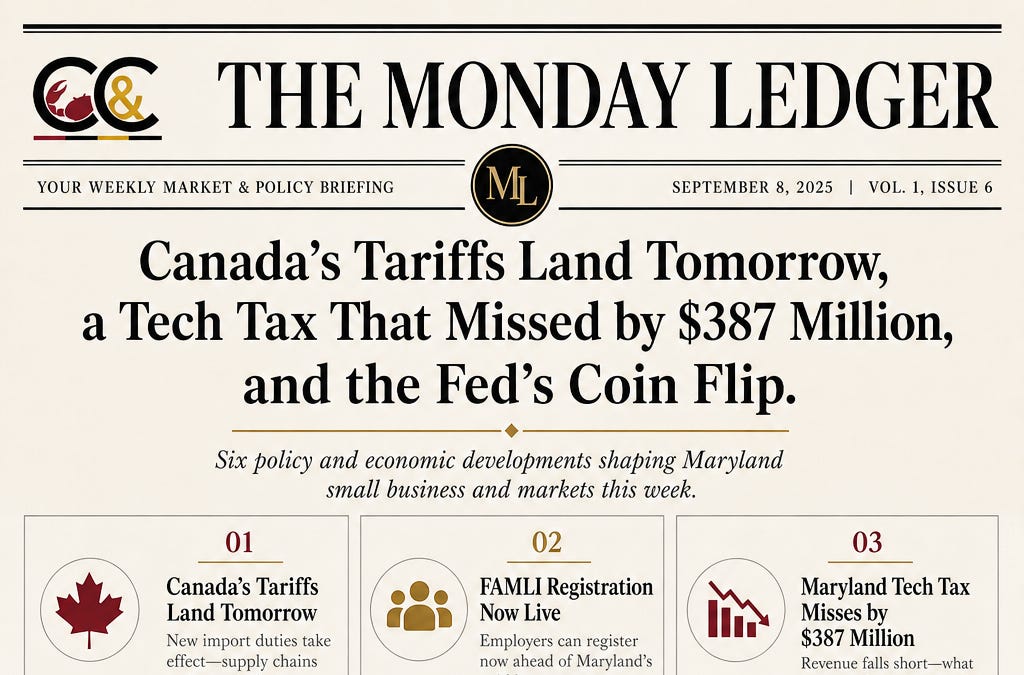
The Monday Ledger: Canada’s Tariffs Land Tomorrow, a Tech Tax That Missed by $387 Million, and the Fed’s Coin Flip
# The Monday Ledger: Canada’s Tariffs Land Tomorrow, a Tech Tax That Missed by $387 Million, and the Fed’s Coin Flip
### Six things that moved for Maryland small business this week — what happened, and what I’d do about each one.
Sep 07, 2026
Coffee’s on. Let’s go through the books.
It’s Labor Day, which means most of you are reading this on the porch and the state’s offices are closed. Good. Because the week that starts tomorrow has more dated deadlines packed into it than any week since spring, and I’d rather you see them now than on Wednesday.
On the ledger this week: Canada’s counter-tariffs on $27.6 billion of U.S. goods take effect at 12:01 tomorrow morning; the state quietly flipped the switch on FAMLI employer registration; Maryland’s 3% tech tax brought in less than a quarter of what Annapolis promised, and the invoices have started to sting; the Fed meets next week with markets calling a rate hike a better-than-even bet; a new “captive audience” law lands October 1 with a $25,000 penalty attached; and there are ten days left on DHCD’s 4% fixed-rate loan round.
1. Canada shoots back at 12:01 a.m. tomorrow
Last week I told you it was coming. Here’s what’s in it. Canada’s counter-tariffs on U.S. goods take effect at 12:01 a.m. on Tuesday, September 8, covering $27.6 billion in imports from the U.S. at rates of 15%, 25%, or 50% depending on the product. Ottawa is matching, dollar for dollar, the 50% U.S. tariff on Canadian goods that took effect August 22. The targeted sectors are steel, dairy, appliances, agricultural equipment, pulp and paper, and electronics — and the list runs to 629 tariff lines, from corrugated boxes and envelopes to bread dough and toilet paper. Goods already in transit to Canada when the clock strikes are exempt; goods that leave your dock Tuesday are not.
Why this matters more here than the national coverage suggests: Canada is Maryland’s single largest export customer, at $2.2 billion in 2025 — 13% of everything the state ships abroad. The retaliation list was built to hit swing-state exports, not ours specifically, but it’s broad enough that a Baltimore County fabricator or an Eastern Shore food processor with a Canadian account should assume they’re on it until they’ve checked. And the other direction has been live for two weeks: the U.S. tariffs on Canadian goods carry no exemption for goods that qualify under USMCA, so Canadian-sourced inputs you’ve been buying since August 22 already cost more, whether or not your supplier has said so yet.
One caveat I’ll state plainly: the U.S. tariffs were imposed under a section of the 1930 Tariff Act that has never been used before, and trade lawyers expect it to be challenged in court. So this could get unwound. It could also escalate. Neither outcome is something you can put on a calendar.
What I’d do: If you sell into Canada, pull your HS codes and check them against Ottawa’s list today — it’s organized by tariff code, so it’s a thirty-minute job, not a project. If you buy Canadian inputs, call the supplier this week and ask for the landed-cost math in writing; the “in transit” exemption means some shipments dodge it and some don’t, and you want to know which of yours are which. And on both sides, this is the moment to read the price-escalation and change-in-law clauses in your contracts — the ones you skipped when you signed — because that language decides who eats a 25% swing.
2. FAMLI registration is live. This is the part you actually have to do.
Last Monday I flagged the September 1 opening of the Declaration of Intent window for employers considering a private paid-leave plan. The bigger news came the same day, with less fanfare: employer registration for FAMLI is now open, and the state is telling employers to register “as soon as possible.” That applies to every employer with at least one Maryland-based employee. No headcount floor, no exemption for the one-person LLC with a part-time helper.
The state’s own summary of the money is worth reading twice. Contributions are split between employer and employee; you can withhold up to half from your people via payroll. If you have fewer than 15 employees, you qualify for the small-employer discount, which exempts you from the employer’s share entirely — the state says more than 80% of Maryland employers will qualify. You still register, you still withhold the employee half, and you still file. The dates that follow are firm: withholding starts with the first pay period in January 2027, the first contribution payment is due April 30, 2027, and benefits — up to 12 weeks of job-protected leave at up to $1,000 a week — begin in January 2028.
The honest read: for most shops under 15 people, this is a payroll-deduction line and a quarterly filing, not a new cost. The risk isn’t the money. It’s finding out about the deduction from an employee who noticed it before you explained it.
What I’d do: Register at paidleave.maryland.gov this month, while it’s a ten-minute chore instead of a December scramble. Then write the one-paragraph employee notice now — what FAMLI is, what comes out of the check starting in January, what it buys them in 2028 — and put it in the drawer. If your payroll provider handles filings, sign the power of attorney early; the state’s been clear that the provider can’t register you, only you can.
3. The tech tax missed its number by $387 million. Your invoices didn’t.
The Comptroller’s Office has now put a preliminary first-year figure on Maryland’s 3% sales tax on IT and data services, the one that took effect July 1, 2025 to help close a $3.3 billion budget hole. The estimate at passage was about $500 million for fiscal 2026. Actual collections: $112.8 million, from roughly 2,900 companies — a shortfall of about 77%, per the Baltimore Sun’s reporting last week, with the most recent quarter still being processed. The office says the original forecast was made “before complete data were available,” which is a polite way of saying nobody knew how many transactions would actually land inside the NAICS codes the law taxes.
To be fair to the forecasters, this isn’t a September surprise. Maryland Matters reported back in March that first-quarter collections had the tax on pace for roughly $50 million — about a tenth of the estimate — so the full year actually came in better than the early read. What’s new is the full-year number and the owner-level detail: a Columbia managed-services firm says the tax costs it an additional $15,000 a month and has pushed it to raise prices and trim services, including cybersecurity; a Frederick computer shop says an employee spends about a day a week hand-building invoices because its billing software still can’t handle the tax. The Maryland Chamber is calling for repeal. A Hagerstown IT provider says some clients have moved billing addresses out of state — which, if it’s happening at scale, would explain a chunk of the shortfall better than any forecasting error. Nobody has the data to say whether it is.
Here’s the part I’d underline. A tax that raises $113 million instead of $500 million doesn’t get repealed in a budget year; it gets replaced or widened. Add the digital ad tax refunds now on the table after last month’s ruling, and Annapolis walks into the 2027 session looking for something north of half a billion dollars. The CNBC ranking that put Maryland’s economy 49th of 50 this summer — the figure the Salisbury chamber was citing on the Shore this week — is the argument against. The budget math is the argument for. I don’t know which wins.
What I’d do: If you buy IT services — and you do, even if it’s just the person who “does the computers” — pull a year of those invoices and confirm the 3% is broken out as a line item, not buried in the rate. It’s deductible either way, but you can’t manage what you can’t see. If you sell them, and your