‘Utter paralysis’: Legacy admissions ban faces tough road in Congress | Higher Ed Dive # ‘Utter paralysis’: Legacy admissions ban faces tough road in Congress The fate of bipartisan bills is in doubt at the congressional level, while state-level proposals have stalled in the legislatures.
highereddive.com · Danielle McLean · September 9, 2026
‘Utter paralysis’: Legacy admissions ban faces tough road in Congress | Higher Ed Dive
# ‘Utter paralysis’: Legacy admissions ban faces tough road in Congress
The fate of bipartisan bills is in doubt at the congressional level, while state-level proposals have stalled in the legislatures.
Published Sept. 9, 2026
By Danielle McLean
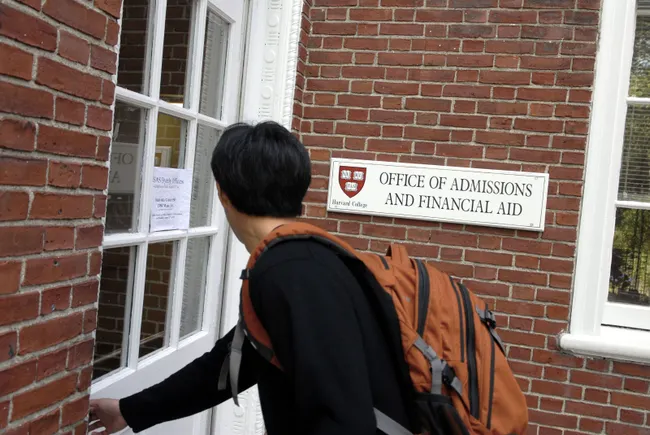
First-year student Winston Yan enters the admissions building at Harvard University on Sept. 12, 2006, in Cambridge, Mass. State-level bills to bar legacy admissions in Massachusetts have failed to gain traction. Glen Cooper via Getty Images
Momentum for banning legacy admissions practices has seemingly tapered over the past two years, as legislation has stalled in state legislatures, the fate of bipartisan congressional bills is in doubt, and the Trump administration hasn’t indicated any interest in taking up the issue.
Since the U.S. Supreme Court’s 2023 decision striking down race-conscious admissions practices, prominent Democrats and Republicans alike have called for or backed legislation that would restrict public and private institutions from giving admissions preferences to the children of alumni or donors. Proponents have included governors, lawmakers, and even the conservative activist who brought the landmark case.
But passing any legislation through Congress at the moment could be an uphill battle, said James Murphy, a senior fellow at Class Action, a group that advocates for admissions reform.
“I don't think there's a question of political will, so much as just the utter paralysis of the U.S. Congress,” said Murphy. “I sit and hope that something will happen that will spark another wave of interest.”
But to date, Murphy noted, that spark hasn't come from the Trump administration.
Still, given recent bipartisan legislation introduced in the Senate to address legacy admissions, a federal move in the near future is not out of the question, said Frederick Hess, senior fellow and director of education policy studies at the American Enterprise Institute, a right-leaning think tank.
Many people are frustrated that well-heeled institutions are collecting federal financial aid while “extending privileges to connected children” so the colleges can secure more donations, Hess said.
“There is a real chance that you could see legislation,” he said, pointing out that there’s common ground on the issue between the “pro-equity left and the populist right."
#### Legacy admissions bans appear in doubt in Congress
Legacy admissions practices have been debated since the Civil Rights era of the 1950s and ‘60s, but the Supreme Court’s decision “sparked new interest" in them, Murphy said.
Since that ruling, in fact, legacy admission bans have garnered rare bipartisan support from congressional lawmakers.
A group of senators recently reintroduced the bipartisan Merit Act, which would tie accreditation to colleges having policies that bar preferential treatment to applicants who are related to their alumni or donors. Sens. Todd Young, R-Ind., and Tim Kaine, D-Va., also introduced the proposal in 2023, but it failed to gain traction.
The reintroduction of the MERIT Act “is encouraging” and signals bipartisan support for eliminating legacy admission policies, Murphy said in an email. But he added he’s not optimistic that it will become law without public support from the White House.
Another Senate bill introduced by Sens. Jeff Merkley, D-Ore., and John Kennedy, R-La., last year would bar colleges with legacy admissions from receiving federal financial aid. A companion bill was introduced in the House shortly after by Reps. Summer Lee, D-Pa., and Young Kim, R-Calif.
“Children of donors and alumni may be excellent, well-qualified students,” Merkley said in announcing the Senate version. “But the fact is they are the last people who should get an additional leg up in the complicated and competitive college admissions process.”
Edward Blum, the conservative activist who brought the case to the Supreme Court that successfully challenged race-conscious admissions, called on Congress to pass legislation phasing out legacy and donor admission preferences.
“Preferences for the children of alumni and major donors have become a quiet, but consequential, form of advantage,” Blum wrote in an April column he co-authored with Young for the National Review.
“I don't think there's a question of political will, so much as just the utter paralysis of the U.S. Congress."
James Murphy
Senior fellow, Class Action
Robert Kelchen, a professor and head of University of Tennessee, Knoxville’s educational leadership and policy studies department, said he believes a legacy admissions ban would pass if it came to a vote as a standalone bill in Congress, as the practice is viewed as benefiting people who have power and privilege.
“In an era where we have populists on both the left and the right, restricting legacy admissions creates some interesting coalitions,” said Kelchen.
But it's a challenge to find the right legislative vehicle to put it in, Kelchen said. Congress has passed relatively little legislation in recent years, largely limited to budget bills, he said.
A legacy admissions ban could potentially be included in a large budget bill. For instance, the FAFSA Simplification Act — legislation that streamlined the form for students applying for federal financial aid — was included in a major government funding bill signed into law in late 2020.
But since a legacy admissions ban lacks a direct fiscal impact,that option is unlikely, Kelchen said in an interview.
After the Merit Act was reintroduced, Kelchen said in an email that he still doesn’t think major legislation will pass gIven how few legislative working days remain on the congressional calendar and the need to prioritize passing a budget.
#### Institutions resist state bans
Following the 2023 Supreme Court ruling, many elite institutions stated they would examine their admissions policies and eliminate barriers to enrolling a diverse class, said Murphy. Those included Harvard, Yale and Brown universities.
Indeed, data shows many institutions did roll back their policies. By 2025, 62 public colleges and universities and 358 private institutions had legacy admissions preferences, the nonprofit Education Reform Now stated in a report. This means at least 92 colleges had scrapped the practice since the 2023 Supreme Court ruling, including high-profile institutions Carnegie Mellon University and Wesleyan University in 2023.
But few elite institutions were among those that did so, said Murphy.
Earlier this year, a Yale report concluded, among other things, that the institution's legacy preferences contributed to the growing distrust in academia. Yale’s president asked a committee to examine the distrust issue in 2025.
“When selective admissions seem so inexplicable — or, worse, tilted in ways that benefit the already advantaged — it should come as no surprise that many Americans do not trust the process,” the Yale report said.
States, however, have also taken on the issue. Since 2023, four states — California, Maryland, Illinois and Virginia — restricted or banned legacy admissions after Colorado became the first to pass such legislation in 2021.
In 2024, then-Virginia Gov. Glenn Youngkin, a Republican, signed a bill passed by the state’s Democratic-controlled Legislature that banned public institutions from giving admission preferences to legacy applicants, arguing he supported merit-based admissions.
When signing California’s ban on legacy admissions that same year, Democratic Gov. Gavin Newsom, argued in a statement that everyone in the state “should be able to get ahead through merit, skill, and hard work.”
But California’s ban, which took effect in fall 2025, did not stop Stanford University from maintaining its legacy preferences, opting for the measure’s punishment that restricts them from receiving state financial aid. The unive