nola.com · Alex Lubben · September 8, 2026
What SpaceX's Louisiana spaceport means for the coast | Business News | nola.com
## A fragile stretch of Vermilion Parish coast is set to become one of the largest launch sites in spaceflight history. What that means for the wetlands around it is still unclear.
- By ALEX LUBBEN | Staff writer
#### Alex Lubben
- Author email (alex.lubben@theadvocate.com) - Sep 8, 2026 - 52 mins ago - 6 min to read
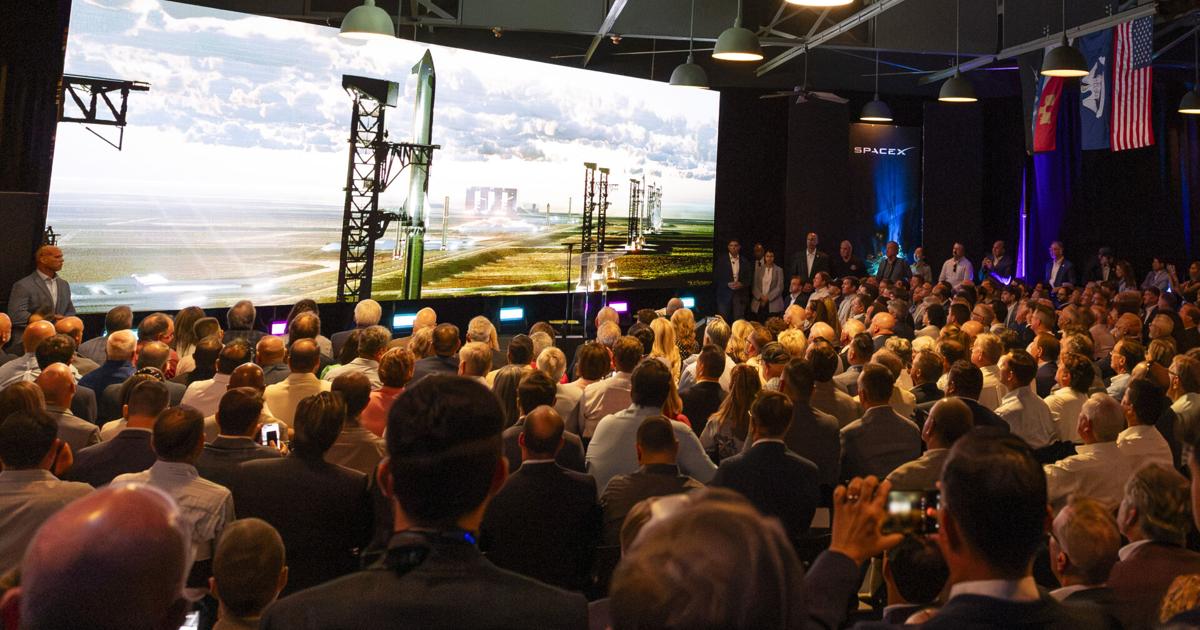
Guests watch a video announcing the SpaceX "Starbase Louisiana" facility near Pecan Island, at Magdalen Place in Abbeville, La., Tuesday, Aug. 25, 2026. STAFF PHOTO BY SOPHIA GERMER
A plan to build what may be the world’s largest spaceport would be supremely ambitious for any location.
But in the marshes of south Louisiana, where a football field of land disappears every 100 minutes, Elon Musk’s grand vision for SpaceX will be confronted with unique challenges.
On top of the technical considerations of building what Musk calls Starbase Louisiana near Pecan Island, coastal restoration groups will be watching closely to see how the project fits into the state’s long struggle against land loss.
SpaceX’s president and chief operating officer Gwynne Shotwell pledged to carry out restoration projects in Vermilion Parish in cooperation with the state’s coastal authority.
“The work includes thousands of acres of marsh creation to reconnect fragmented wetlands and help restore the natural storm buffer that this coast has lost,” she said.
The sun rises over marshland along Freshwater City Road near where SpaceX is planning to build a multibillion-dollar spaceport in Vermilion Parish, La., Wednesday, Aug. 19, 2026. STAFF PHOTO BY SOPHIA GERMER
But the scale of the project and the complex circumstances surrounding it have raised a host of questions whose answers are not yet clear.
They include how a settlement in a lawsuit over coastal damage, through which SpaceX has acquired access to the land, will ultimately benefit restoration efforts. A separate issue involves how a federal push to speed the regulatory approval process for aerospace developments may affect the project.
Work to restore the state’s coastline has long been viewed as vital in south Louisiana. There are hopes that SpaceX’s plans will serve as a win-win, stoking economic development while providing needed restoration dollars, but there are few details so far of how the company will contribute.
Gwynne Shotwell, president and CEO of SpaceX, speaks during the announcement of plans to build a SpaceX spaceport on the Louisiana coast south of Pecan Island Tuesday, August 25, 2026, in Abbeville, La. STAFF PHOTO BY LESLIE WESTBROOK
“As a new arrival to our state, SpaceX will share the responsibility to protect our coast,” said Kim Reyher, executive director of the Coalition to Restore Coastal Louisiana, the state’s oldest coastal advocacy organization.
Referring to the state's 50-year blueprint for salvaging as much land as possible, Reyher said: “An investment of this magnitude must bring significant new resources to protect and restore the wetlands of the region and accelerate implementation of Coastal Master Plan projects.”
Michael Hare, executive director of the state's Coastal Protection and Restoration Authority, said that SpaceX has proactively worked with his agency since March to formulate plans to maintain the coast and mitigate impacts the new spaceport may have.
“I believe their overall investment is going to accelerate coastal restoration in this area at a pace that we would have never been able to accomplish had they not come,” Hare said, adding that he appreciated that the project would provoke “legitimate public concern.”
“I have confidence in our regulatory agencies to enforce our rules, our regulations, to the highest standards,” he said.
The massive $100 billion spaceport could be among the largest launch sites in the history of spaceflight. It is slated for construction in a rural area that’s historically been a duck hunting hotspot, a fragile part of the coastline that has lost wetlands in recent decades and is expected to lose more as sea levels rise.
An investment that size gives SpaceX a strong reason to keep its land from eroding. To Vermilion Parish President Chad Vallo, that alone could provide significant storm surge protection for the region.
“They’re not going to put their site in a place where there’s one storm and they’re going to lose it. That’s coastal restoration. That’s protecting Pecan Island, all the way up to Gueydan,” he said. “I think just their site is going to offer a huge amount of protection.”
### 'Lack of transparency'
Louisiana has lost an area the size of Delaware since the 1930s, a crisis driven by compounding factors. Since the early 20th century, the Mississippi River has been straitjacketed by levees and no longer overflows its banks as it used to, starving wetlands of the sediment needed to replenish them. Sea level rise has also contributed, as have oil and gas companies, by cutting canals through the marsh and accelerating subsidence through fossil fuel extraction.
Governor Jeff Landry laughs as he talks to people after the SpaceX announcement at Magdalen Place in Abbeville, La., Tuesday, Aug. 25, 2026. STAFF PHOTO BY SOPHIA GERMER
The state’s plan to protect the coast involves dozens of projects that include marsh creation, barrier island restoration, and, until recently, large-scale sediment diversions that would have allowed the river to flow back into wetlands. Under Landry, diversion plans have been scuttled in favor of other projects, like marsh creation and rock jetties.
But coastal groups ask what specific investments the company will make in coastal restoration, both near the launchpads and potentially elsewhere throughout the state. Those details may have remained out of sight because state officials close to the project have signed nondisclosure agreements to maintain the confidentiality of negotiations with the company.
“A lot of the frustration, from my point of view, lies in the lack of transparency in all of this,” said Alisha Renfro, a coastal scientist with the National Wildlife Federation. “How do you minimize impacts? We’re all flying around blind.”
As part of the development of the spaceport, SpaceX acknowledges that some wetlands will be damaged. The company has acquired around 125,000 acres of land along the coast, about 40,000 of which it plans to develop as part of its new launch site, according to the company. Building it will likely involve expanding roads, or filling in new land in areas that are now marsh.
Mark Davis, an environmental law professor at Tulane University, noted the Federal Aviation Administration’s proposal to waive 13 laws that form the backbone of the U.S. permitting and environmental regulatory framework from applying to aerospace developments, including the Clean Water Act.
If that law is waived, he said SpaceX might not have to protect other marsh areas when it fills in wetlands around its new launch site through a process called mitigation, which is largely governed by the Clean Water Act.
“If we’re going to do this, I hope it goes well,” Davis said. But he questioned the result "if you're not doing mitigation under the Clean Water Act, where there are protocols for how you calculate the amount of mitigation, where the mitigation is supposed to be."
Hare pushed back, saying that regardless of the FAA rule, the spaceport will be subject to the Clean Water Act.
“They’re still going to have to go through their normal permitting process. It will require mitigation,” he said. “I don’t think there’s any question of that whatsoever."
### 'Trump speed'
Landry, SpaceX and federal officials have all stressed that the company will voluntarily contribute to the state’s coastal restoration initiatives, regardless of whether it’s required to do so.
Adam Telle, until recently the assistant secretary of the Army for Civil Works and just p