infonews.ca · Jennifer Sinco Kelleher And Geoff Mulvihill · September 5, 2026
What to know about states' efforts to limit corporate donations in politics | iNFOnews.ca
# What to know about states’ efforts to limit corporate donations in politics
- By Jennifer Sinco Kelleher And Geoff Mulvihill | The Associated Press - May 11 2026 09:08 PM
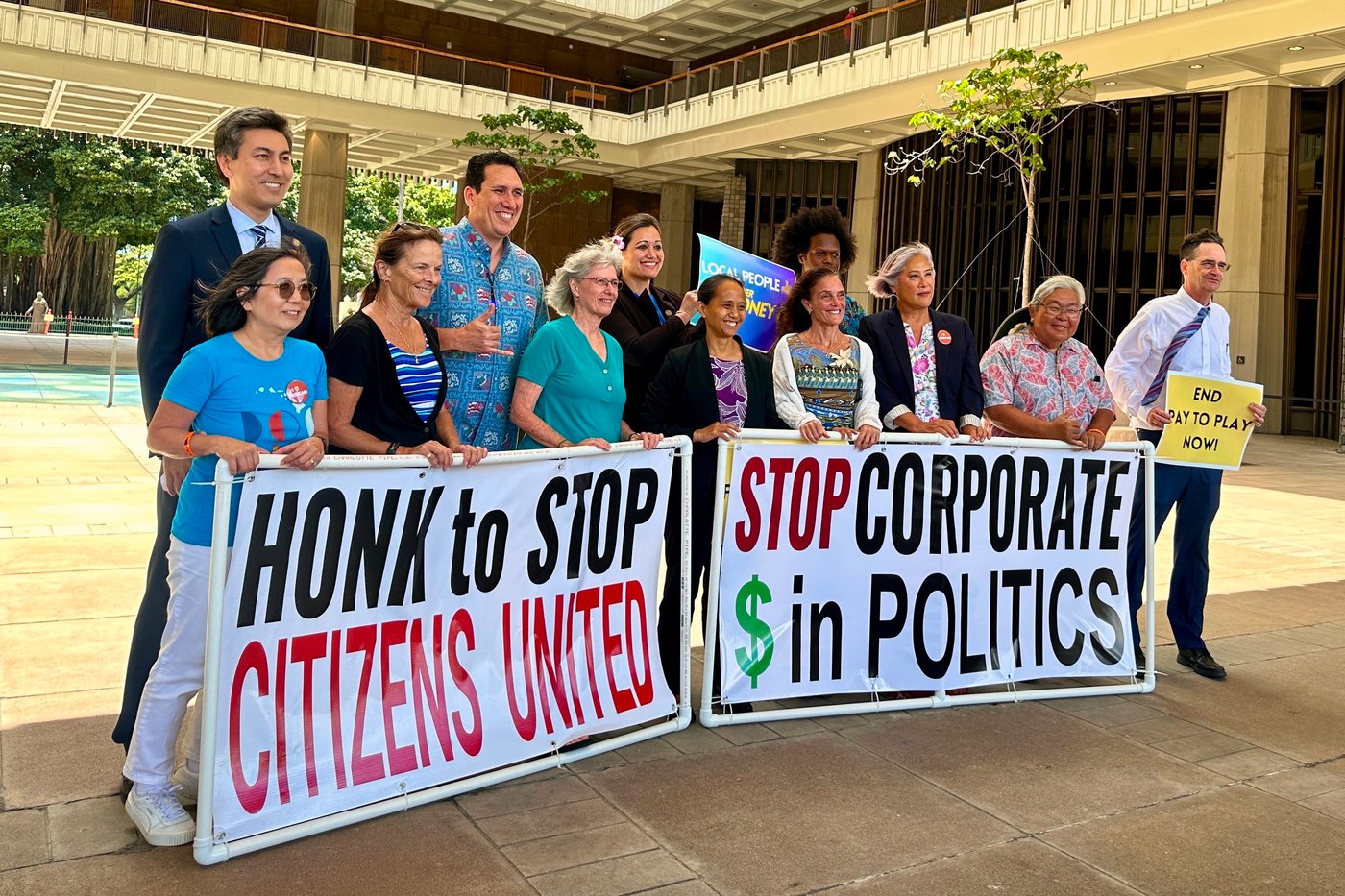
Hawaii lawmakers and activists pose for a photo after discussing a bill that seeks to limit corporate money in politics in Honolulu on Thursday, April 23, 2026. (AP Photo/Jennifer Sinco Kelleher)
HONOLULU (AP) — Two states could try a new way to reduce the influence of corporations and hard-to-track “dark money” groups that have been able to spend unlimited amounts on politics since the Supreme Court’s 2010 Citizens United v. Federal Election Commission ruling.
Hawaii lawmakers on Friday sent a bill to the governor that would redefine corporations in a way that precludes spending on elections. A volunteer group in Montana is gathering signatures in hopes of putting a similar issue to voters in November.
Supporters say voters dislike corporate and dark money in elections and this effort meets a need. Detractors say states can’t pass laws to skirt Supreme Court decisions they don’t like.
Similar legislation has been introduced in at least 14 states besides Hawaii, but none of those bills have gotten very far.
Political spending has changed since Citizens United
Citizens United, a conservative group, wanted to run TV commercials promoting its anti-Hillary Clinton movie when she was running for president in 2008. The high court’s ruling in its case two years later effectively struck down a ban on corporate and union election spending as long as they don’t donate directly to any campaigns.
The ruling has benefitted Democrats and Republicans. The campaign finance watchdog group OpenSecrets tracked more than $4 billion in outside political spending in the 2024 federal elections — almost 12 times as much as in 2008.
Some of that came from dark money groups that aren’t required to disclose donors, and the Brennan Center for Justice tallied a record $1.9 billion in that type of spending in 2024. Dark money has also played a part in some state-level races.
Justin Levitt, a professor at Loyola Law School who studies campaign finance law, said keeping companies from spending on elections might not make a big difference in how political spending works, noting that far more is spent by wealthy people such as Elon Musk.
One advocate’s idea: Redefining corporate powers
Americans want to undo the Citizens United ruling, according to Tom Moore, a former Federal Elections Commission lawyer who is now a senior fellow at the Center for American Progress. The think-tank in Washington, D.C. is pushing to redefine corporations to ban spending on campaigns but allow them to lobby lawmakers.
The prohibition would also include the nonprofit organizations involved in dark money spending.
“This is a genuinely new approach to getting Citizens United out of America’s politics that is based on absolutely foundational corporation law,” he said.
If just one state adopts it, Moore said, it would be tested in court.
It’s up to the governor in Hawaii and could go to voters in Montana
Hawaii Gov. Josh Green, a Democrat, hasn’t said whether he’ll sign the bill. He has to say by June 30 if he intends to veto it.
“This is an instance where a small state has a chance to make big waves on the national scene,” said state Sen. Karl Rhoads, a Democrat, who introduced the legislation. “I think we should take advantage of it.”
The office of Hawaii Attorney General Anne Lopez, a Democrat, opposed the bill, arguing in part that will be difficult and costly to defend in court.
Separately, volunteers are gathering signatures hoping to put the corporate redefinition idea — branded as The Montana Plan — before voters in that state in November.
Montana’s Supreme Court ruled in April that the effort could proceed even after Republican state Attorney General Austin Knudsen said it violates the requirement that ballot initiatives stick to one subject.
“It really resonates with citizens,” said Jeff Mangan, a former Montana state commissioner of political practices who’s leading the ballot effort. “They probably see it because they live it.”
But would it work?
Bradley Smith, a Republican former member of the Federal Election Commission, says Moore’s idea is not likely to pass muster in court.
“The mistake I think supporters of this are making is thinking you can ignore the substance of a Supreme Court ruling by semantic lawyerly tricks,” he said.
Lower courts likely won’t approve a measure that aims to circumvent a Supreme Court ruling and would probably reject any law that ties the provision of general government services to the behaviors of the recipients, Smith said.
If the measures take effect, he said, companies might withdraw from states rather than curtail their political spending.
Loyola’s Levitt says he’s not sure whether the effort would work, but he knows who would decide.
“The one thing I am absolutely sure of is if it got the signatures and is passed by the Montana public and is approved by the Montana courts, that the Supreme Court will want a crack at it,” he said. “There are a lot of steps between here and there.”
Mulvihill reported from Haddonfield, New Jersey.
Hawaii Sen. Karl Rhoads speaks at a news conference about a bill that seeks to limit corporate money in politics in Honolulu on Thursday, April 23, 2026 (AP Photo/Jennifer Sinco Kelleher)
September 05 2026 10:00 AM