Grand Junction Housing Faces Colorado’s $130 Million Funding Cut # A $130 Million Sweep Threatens Western Colorado’s Housing Boom and Sends the Fight to the Ballot Box Grand Junction has exceeded its Proposition 123 housing commitment, with projects advancing across the Grand Valley.
westernslopetrellis.com · September 8, 2026
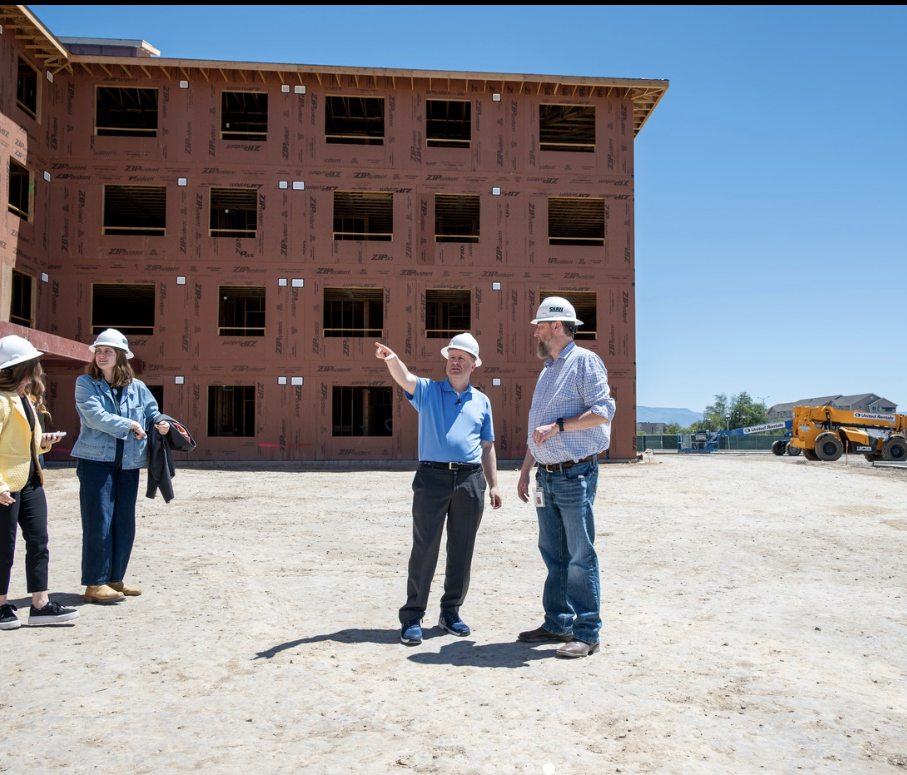
Grand Junction Housing Faces Colorado’s $130 Million Funding Cut
# A $130 Million Sweep Threatens Western Colorado’s Housing Boom and Sends the Fight to the Ballot Box
Grand Junction has exceeded its Proposition 123 housing commitment, with projects advancing across the Grand Valley. But Colorado’s $130 million housing-fund transfer raises questions about financing the next round of affordable homes.
Western Slope Trellis Staff September 08, 2026 – 5 min read
In Clifton, a planned 60-home rental community has secured financing and is preparing for construction next spring. In Grand Junction, Liberty Apartments broke ground in August, while the Salt Flats development is expected to bring hundreds of apartments and homes for sale to a site near 28 Road.
Each has received support through Proposition 123, the affordable housing measure Colorado voters approved in 2022. Together, they show how state funding can help communities acquire land, attract investment and build homes that would otherwise be difficult to finance.
But funding for the next round of projects has taken a substantial hit. Colorado lawmakers approved a $130 million transfer from the State Affordable Housing Fund to the general fund this year as they addressed the state’s budget shortfall. The transfer was among the housing reductions considered during the legislature’s budget-balancing deliberations.
For Grand Valley communities, the question is how much of their recent progress they can sustain.
## Grand Junction has exceeded its housing commitment
Proposition 123 dedicated a portion of existing state income tax revenue to affordable housing without increasing income-tax rates. Its formula is equivalent to a tax of one-tenth of one percent on federal taxable income. The state’s original fiscal analysis projected $290 million for housing in the first full fiscal year, 2023–24.
The money supports land purchases, development financing, homeownership assistance and other housing programs. Local governments participate by making housing commitments and meeting program requirements. During the first three-year cycle, participating communities committed to increasing their affordable housing stock by 3% annually and establishing an expedited review process for qualifying developments.
Grand Junction committed to 374 qualifying units. The state confirmed in April that it had met that commitment, and by July 8, the city reported 588 approved units, a surplus of 214.
Those figures include more than newly built homes. Qualifying work can include rehabilitation and preservation of existing affordable housing, as well as new construction. New homes can also count before completion, when a building permit is issued, vertical construction begins or another eligible milestone is reached. The city’s July update lists both completed rehabilitation projects and developments still under construction.
The surplus also gives Grand Junction a way to help its neighbors. In May, City Council approved a regional agreement with Mesa County, Fruita and Palisade. According to the city, the arrangement allows qualifying units beyond one community’s commitment to help other participating communities meet housing goals and maintain funding eligibility.
## Where the money is going
At Salt Flats, the connection between state funding and local development begins with the land.
Grand Junction used a $2.2 million Proposition 123 land-banking grant and $1 million in city funds to acquire the 21.78-acre property at 450 28 Road. The city’s August project announcement estimated approximately 450 homes at full buildout, including apartments and homes for sale. A separate $2 million More Housing Now infrastructure grant, matched by $800,000 in city funding, will support roads, utilities, sidewalks and drainage for the development.
Juniper Grove, developed by Rural Homes, is planned as a 48-home neighborhood for income-qualified buyers. Another Salt Flats development, Ascent, received a $1.95 million Proposition 123 concessionary debt award. Its 144 apartments are planned for households earning between 30% and 70% of area median income. According to the city’s project information, the award is one part of the financing needed to move Ascent forward and maintain its affordability.
In Clifton, Crawford Commons is expected to bring 60 townhome-style rental homes to land Mesa County donated at 32½ Road and Friendship Drive. Housing Resources of Western Colorado and Evergreen Real Estate Group are developing the community for households earning between 30% and 80% of area median income.
CHFA announced a housing tax-credit award for Crawford Commons in May. The developers identify it as a federal 9% Low-Income Housing Tax Credit award and describe the project as Clifton’s first development to receive that type of award in 25 years. Their September announcement projects construction beginning in spring 2027 and completion in fall 2028. The project also received a $2.4 million Proposition 123 concessionary debt award, announced by the state on July 21.
Liberty Apartments reached its groundbreaking on August 25, with Gov. Jared Polis attending. Its first phase will provide 72 workforce housing units, supported by nearly $8 million in Proposition 123 equity funding. The development is designed to achieve net-zero energy performance, according to the governor’s announcement.
These projects combine state assistance with other financing and local contributions. Losing access to one source can make a development harder to assemble, even when its other partners remain committed.
## What the $130 million transfer changes
House Bill 26-1360 directed the state treasurer to transfer $130 million from the State Affordable Housing Fund to the general fund on June 30. It also reduced the subsequent transfer to the Affordable Housing Financing Fund, the Proposition 123 branch that supports land banking, equity investments and concessionary debt.
The legislation did not end Proposition 123. It reduced resources available through a program that communities and developers have used to make housing financially feasible.
For the 2026–27 fiscal year only, the law also changes program funding priorities, placing concessionary debt first, followed by equity investments and land banking.
The consequences could reach projects years away from construction. Land-banking assistance helps secure sites before development is possible. Equity funding can close the gap between what a project costs and what its other financing sources will cover. Salt Flats illustrates why those early investments matter: acquiring the property gave the city a place where several housing developments could take shape.
Less funding could mean fewer awards, longer waits or more time spent finding replacement financing. Determining the local impact will require identifying which upcoming Grand Valley projects need additional state support and whether they can proceed without it. The funding reduction alone does not establish that developments already announced will stop.
## New rules for the next funding cycle
While lawmakers reduced funding, they also changed how communities qualify. Beginning with the 2027–29 housing commitment cycle, House Bill 26-1313 replaces the previous uniform percentage-growth requirement with a calculation based on recent residential building-permit activity and county job growth. It also provides additional credit for specified housing categories, including qualifying homes for sale and homes restricted to households earning no more than 40% of area median income.
For smaller towns, where one development can account for several years of housing activity, the calculation may be especially consequential. Local governments must file their next-cycle commitments by November 1, 2026. Meeting the requirements preserves access to the program, although individual projects must still compete for funding.
## November’s tax debate adds